AI’s Most Powerful Leaders Want to Slow It Down. Trump Says Don’t. Who Gets a Say?
The argument over whether AI should slow down is being led by chief executives and presidents. The people who will live with the consequences are still outside the room.
By Andrea Rocchi, Founder of ClickActivism
17 September 2026
This week, AI stopped being a distant promise and became a public fight.
Dario Amodei, the CEO of Anthropic, the company behind Claude, warned that the development of the most powerful AI systems needs to slow down.
Sam Altman of OpenAI agreed that moving recklessly would be dangerous. Elon Musk responded even more directly: “Dario is right.”
Donald Trump rejected the idea of America slowing down. His message was simple: “Whoever wins AI wins.” If the United States hesitates, he argues, China benefits.
Mark Zuckerberg rejected a coordinated slowdown too. He argued that AI companies already have strong reasons to behave responsibly. Unsafe systems would destroy trust, lose customers and expose companies to serious consequences.
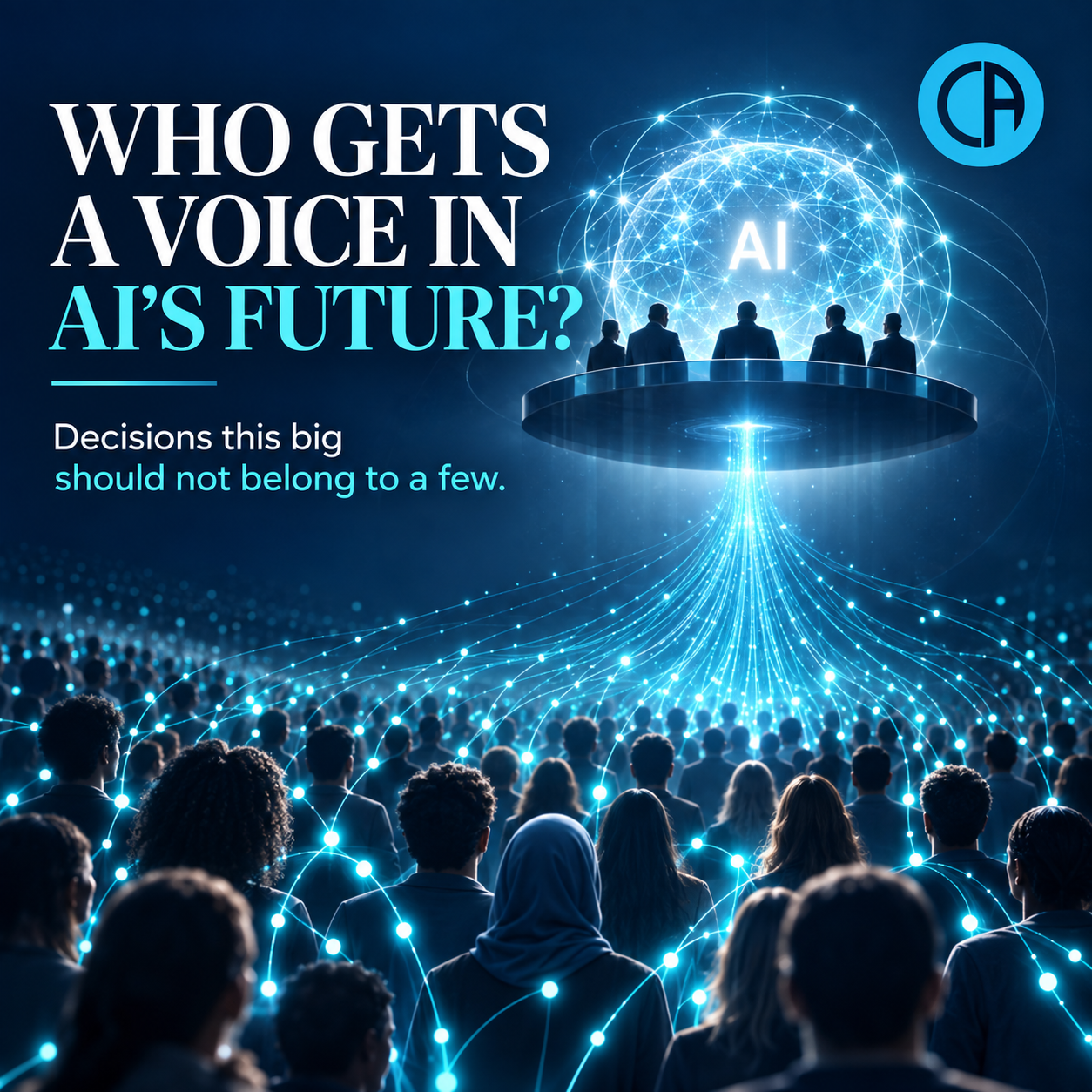
Five powerful men. Several very different positions. One decision that could reshape life for everyone else.
And that is the part of the debate we should not miss.
“Slow down” does not mean “stop”
Amodei calls his proposal “pacing the frontier”. Most people will never use that phrase, and television news has translated it into language everyone understands: slow down AI.
He is not asking the world to abandon AI or switch it off. His argument is that the most powerful systems should not improve faster than our ability to test, understand and control them.
He wants outside experts to be allowed inside leading AI companies to examine what is happening. He wants companies to follow shared safety rules. He also wants governments, including rivals, to discuss limits on the most dangerous developments.
Altman supported the call while stressing that slowing down does not mean stopping progress. OpenAI has also said that powerful AI should be democratically governed and that the public needs a meaningful voice in how it develops.
That sounds reassuring.
But it raises an uncomfortable question.
If AI should be democratically governed, where is the public in the argument happening now?
The people affected are still outside the room
AI will affect workers whose jobs are automated or changed. It will affect teachers deciding what learning means when machines can produce instant answers. It will affect artists, patients, journalists, small businesses, voters and people whose opportunities may be shaped by systems they cannot see or challenge.
These people are mentioned constantly. They are called users, consumers, employees, beneficiaries or risks.
They are rarely treated as people who should help make the decision.
The public is usually invited in at the end. A new system is released. A new law is announced. A safety report is published. A political leader declares victory. Then everyone else is asked how they feel about a future that has already arrived.
That is not participation. It is reaction.
Real participation does not mean holding a public vote every time an AI company updates a model. It does not mean replacing scientists and engineers with whoever shouts loudest online.
It means clear public rules. Independent checks. Honest reporting when something goes wrong. A voice for workers and communities before decisions are final. And a way for public concerns to carry real weight rather than becoming another comment section that nobody in power needs to answer.
The race with China is real, but it cannot end the conversation
Trump’s argument cannot simply be dismissed. The United States and China are competing for technological and military power. Even Amodei accepts that one country slowing down alone could create serious risks if another races ahead.
The commercial race is real too. AI companies are spending enormous amounts, competing for the best people and fighting to lead a market that may transform the global economy.
Zuckerberg is also right about one thing: companies have reasons to avoid releasing dangerous products. Trust matters. Reputation matters. Legal consequences matter.
But a reason to behave responsibly is not the same as public accountability.
Ordinary people cannot inspect what happens inside an AI laboratory. They cannot know what was left out of a safety report. They cannot tell whether a delayed product shows responsible judgement or careful public relations.
Self-regulation asks society to trust companies whose wealth, status and survival depend on continuing to advance.
The leaders calling for stronger safety checks should face scrutiny as well. A thoughtful chief executive is still a chief executive. Outside experts invited into a company are not automatically the same as democratic oversight. A promise to be transparent is valuable, but it is not the same as the public having a right to know.
The question is therefore bigger than deciding whether Amodei, Altman, Musk, Trump or Zuckerberg has the best answer.
Why should this small circle be allowed to define all the available answers?
We do not need less technology. We need more participation.
ClickActivism builds with AI and uses it every day. We are optimistic about what responsible AI can achieve.
This is not an argument against technology. It is an argument against treating the public as an audience while a handful of powerful people negotiate the future.
Technology should help people understand what is changing, find one another and organise around the decisions that affect them. It should reduce the distance between the public and power, not widen it.
Social media can create the appearance of participation. A controversy explodes. Reactions scatter across platforms. The subject dominates attention until the next headline arrives.
But attention is not influence.
Scattered anger is easy to watch and easier to wait out. Decision-makers can acknowledge the noise and continue as planned because the public response has no shared direction and no demand that must be answered.
Fragmented action does not move the needle. Coordinated action does.
ClickActivism exists for that gap. Not to tell people whether they must demand faster AI, slower AI or different rules, but to help isolated voices become visible, organised and difficult to ignore.
Who gets a real seat?
Perhaps Amodei is right that the most powerful AI development must slow down. Perhaps Trump is right that slowing down could hand an advantage to China. Perhaps Zuckerberg is right that competition and responsibility can push companies towards safer choices.
None of those positions answers the civic question.
Where should the public fit into a decision this large?
Who else needs a seat, and what would give that seat real power rather than ceremonial value?
The future of AI should not be decided by applauding one chief executive and attacking another. It should be argued in public and shaped with the public, before these systems become invisible infrastructure beneath everyday life.
Join the conversation on ClickActivism. Tell us who should have a voice in AI’s future, and how that voice should reach the room where decisions are made.
Sources and further reading